
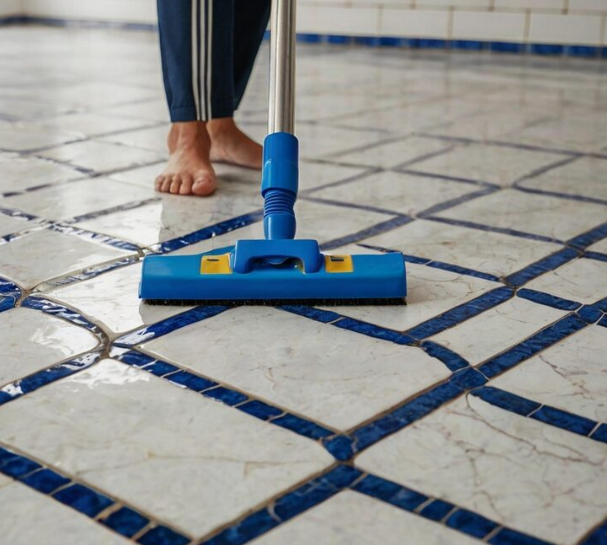
Replacing tiles is the answer nobody asked for. You’ve got perfectly functional flooring — structurally sound, visually decent — and someone tells you the fix is to rip it all out and start again. That’s not a solution. That’s an invoice dressed up as advice.
Slippery tiles are a genuine liability, especially in Dubai’s climate where air conditioning creates condensation, outdoor heat causes rapid temperature shifts, and water-heavy environments like hotel lobbies, gym changing rooms, and residential bathrooms see constant foot traffic. The risk is real. But the fix doesn’t have to be dramatic.
Here’s what actually works — and why most people are solving this problem wrong from the start.
The Misconception That’s Costing You Time and Money
Most business owners assume slippery tiles are a material problem. Wrong surface, wrong finish, wrong choice from the beginning. So they plan for replacement.
The actual problem, in the majority of cases, is surface chemistry. Polished and semi-polished tiles become slippery because their surface is too smooth to create meaningful friction when wet. That’s a surface condition — not a structural one. And surface conditions can be changed without touching the substrate underneath.
The tile isn’t broken. The surface just needs to be treated like what it is — a safety risk with a fixable cause.
Once you understand that, the entire conversation shifts from demolition to treatment.
Why Dubai Specifically Makes This Worse
This isn’t generic flooring advice. Dubai creates specific conditions that accelerate the problem.
Indoor environments are heavily air-conditioned. When people walk in from 42°C heat into a 20°C lobby, their shoes carry moisture and the floor itself can develop condensation. You add marble or polished porcelain — both widely used in UAE commercial and residential builds — and you have a surface that behaves like ice under the wrong conditions.
Then there’s the humidity that rolls in from the coast, particularly in areas like Dubai Marina, JBR, and Business Bay. Outdoor tiled walkways, poolside areas, and building entrances take a consistent beating from this.
If your tiles are in any of these environments, passive maintenance isn’t enough. You need to actively make tiles non slip — not hope the problem stays manageable.
The Methods That Actually Work
Anti-Slip Chemical Treatments
This is the most underused solution in the market, and the most effective for smooth tiles that are already installed.
Chemical anti-slip treatments work by etching microscopic pores into the tile surface — invisible to the eye, but significant in terms of grip. The texture creates traction without changing the appearance of the tile. For polished marble, glazed porcelain, or ceramic floors, this is often the cleanest answer.
A facility manager at a mid-size hotel in Dubai Media City had this problem on their pool deck tiles. Guests were slipping. Replacement wasn’t an option during the season. A chemical treatment was applied over a single weekend. No downtime beyond the application window, no visual change to the tile, and the slip resistance rating moved from R9 to R11 — a measurable improvement under European classification standards.
The treatment is also reapplicable. It doesn’t last forever, but a professional application typically holds for two to three years under moderate traffic. For high-footfall commercial environments, annual assessment makes sense.
If you’re looking to make tiles non slip without touching the structure of the floor, this is where you start.
Anti-Slip Coatings
Different from chemical etching — coatings sit on top of the tile rather than altering the surface at a molecular level. They create a thin, grippy layer that increases friction when wet.
The tradeoff is visibility. Some coatings have a slight sheen or texture change, which matters if your floors are a design feature. In utility areas — commercial kitchens, changing rooms, staff corridors, construction site welfare units — this isn’t a concern. In a luxury residential lobby, it might be.
The advantage is durability. A quality anti-slip coating, correctly applied, handles heavy commercial traffic well. For warehouses, workshops, and industrial environments in Dubai’s industrial zones — Al Quoz, JAFZA, DIC — this is often the preferred route.
Anti-Slip Tape and Strips
Practical. Immediate. Not always pretty.
Anti-slip tape works well on stair nosings, ramp edges, and specific high-risk zones where you need a targeted fix quickly. It’s not a whole-floor solution, but it’s a legitimate one for isolated problem areas.
The honest limitation: in high-traffic areas, tape edges lift. In wet environments, adhesion degrades faster than the manufacturer will admit. Budget for replacement every six to twelve months and factor that into the decision.
For staircases in residential buildings or step edges in commercial spaces, anti-slip strips are genuinely useful. Don’t dismiss them because they’re low-tech.
Textured Overlay Systems
For outdoor tiles, pool surrounds, and areas where the floor takes serious weather or chemical exposure, a textured overlay system is worth considering.
This involves applying a new surface layer — typically epoxy or polyurethane-based — directly over the existing tile. It adds texture, improves grip significantly, and can handle Dubai’s UV exposure without degrading quickly.
The floor looks and functions differently afterward. That’s either a benefit or a drawback depending on your context. In a commercial kitchen or a gym, new texture over old tile is a straightforward improvement. In a boutique hotel corridor, you’d want to think harder about the aesthetic outcome.
How to Make Bathroom Tiles Non Slip — Specifically
Bathrooms deserve their own section because the risk profile is different.
You’re dealing with a confined space, often limited natural light, surfaces that are constantly wet, and users who may be elderly, young, or physically compromised. In residential properties and hotel rooms, this is where the most serious slip incidents happen.
The approach to how to make bathroom tiles non slip depends on what you’re working with. Ceramic and glazed tiles respond well to chemical treatment — same principle as above, applied in the shower area and on the bathroom floor. For natural stone like travertine or limestone (common in higher-end Dubai properties), be careful. Not all chemical treatments are compatible with every stone type. Get professional advice before applying anything.
A non-slip bath mat addresses the symptom, not the cause. It also creates its own hazard if it shifts underfoot. It’s not a solution — it’s a temporary patch that gives people a false sense of security.
Knowing how to make bathroom tiles non slip properly means treating the tile itself, not adding things on top of it.
For shower floors specifically, professional anti-slip treatments applied by certified flooring specialists are the benchmark. The cost is modest relative to the liability it removes.
What This Costs — And What It’s Worth
| Method | Approx. Cost (Dubai) | Best For | Lifespan |
| Chemical anti-slip treatment | AED 8–20 per sqm | Polished tiles, bathrooms, lobbies | 2–3 years |
| Anti-slip coating | AED 15–35 per sqm | Industrial, high-traffic commercial | 3–5 years |
| Anti-slip tape/strips | AED 2–8 per linear metre | Stairs, edges, spot treatment | 6–18 months |
| Textured overlay system | AED 40–80 per sqm | Outdoor, poolside, heavy exposure | 5–10 years |
These are indicative figures. Actual pricing varies by area, tile condition, and scope. A supplier quoting significantly below these ranges is either cutting corners on the product or the application. Both matter.
The Professional Route — When DIY Stops Making Sense
For small domestic fixes — a bathroom, a balcony — a DIY approach is viable if you source the right product and follow application instructions precisely.
For anything commercial, anything with significant foot traffic, or anything where a slip incident carries legal and reputational consequence, bring in professionals. Non Slip Concrete And Floor Coating Services in Dubai exist precisely for this — and Anti Slip Floor Solution and Flooring Experts in Dubai will assess your surface type, traffic load, and environment before recommending anything. That diagnosis matters. The wrong treatment on the wrong tile creates problems of its own.
The liability exposure for a business in Dubai from a recorded slip incident is not trivial. The cost of professional treatment is.
FAQ
My tiles look fine and aren’t visibly worn. Why are they still slippery?
Surface finish is the issue, not surface condition. Polished tiles are manufactured to be smooth — that’s the aesthetic. Smoothness and slip resistance are in direct opposition when water is involved. Your tiles can be in perfect condition and still be a hazard.
Will anti-slip treatment change how my tiles look?
Chemical treatments are largely invisible — that’s the point. Coatings can alter sheen slightly. If your tiles are a key design element, ask the contractor to treat a small test area first before committing to the full floor.
How do I make bathroom tiles non slip in a rental property where I can’t make structural changes?
Chemical treatment doesn’t alter the tile permanently and is unlikely to conflict with tenancy restrictions. Check your agreement, but this is typically a maintenance decision, not a structural one. Anti-slip strips on shower floors are another low-impact option.
How often does treatment need to be reapplied?
For moderate residential use, every two to three years. For commercial environments with daily heavy traffic, annual assessment is sensible. A reputable contractor will tell you honestly when reapplication is warranted rather than selling you unnecessary service.
Can I make tiles non slip on an outdoor surface that gets direct sun?
Yes, but product selection matters. UV-stable coatings and overlay systems are formulated for this. Standard indoor treatments degrade faster under direct sun exposure. Specify the outdoor context when getting quotes.
The floors you have are, in most cases, the floors you can keep. Slippery tiles are not a design failure or a permanent problem — they’re a maintenance gap that has a clear, cost-effective answer.
Get the surface assessed properly, choose the method that fits your environment and traffic load, and use professionals for anything at scale. That’s the whole strategy.