
Most people who have had a floor treated for slip resistance do not know what actually happened to it.
They know the result: the floor grips better when wet. But ask what the treatment did to the surface at a molecular level, and the honest answer is: something chemical. Which is accurate but not useful when you are trying to decide whether to trust it, how long it will last, or why one provider’s treatment costs three times another’s.
The science is specific. Understanding it changes how you evaluate what you are buying and what questions to ask.
This guide covers how anti slip coatings work at the surface level, why some produce lasting results and others do not, and what the difference between a genuine treatment and a marketing label actually looks like in practice.
Why Tiles Become Slippery: The Physics Before the Chemistry
To understand what anti slip treatments do, it helps to understand what makes a tile slippery. The answer is friction — or more precisely, the lack of it.
When a foot contacts a floor, those tiny peaks interlock and create resistance — grip.
When water, oil, or soap gets between foot and tile, it fills those microscopic valleys and creates a film that prevents the peaks from interlocking. The surfaces hydroplane. This is what “slippery” means at a physical level: a lubricating film preventing asperity contact.
The key variable is surface texture. A rough tile has deep asperities that a lubricating film cannot fully flood. A highly polished tile has almost no asperities — even a thin film of water is sufficient to hydroplane across it. This is why the most beautiful tiles are often the most dangerous: the polishing that creates their appearance eliminates the texture that would provide grip.
This is also why anti slip coatings and treatments exist: to restore micro-texture to surfaces that have been polished, glazed, or worn smooth. They are solving a physics problem with chemistry.
The Two Fundamental Approaches: Modify the Surface or Add to It
All anti slip coatings work through one of two fundamental mechanisms. Understanding the difference explains why treatments behave differently, last different lengths of time, and produce different visual outcomes.
The first approach is surface modification: creating permanent micro-texture in the tile material. An acid-based or enzymatic solution is applied, dwelled for a calibrated period, then neutralised and rinsed. The chemistry etches micro-channels into the glaze — invisible but changing the asperity profile so fluid cannot form a continuous hydroplaning film. The result cannot be mopped away or polished off.
Because this approach modifies the tile material itself, the result is permanent in a meaningful sense: it cannot be mopped away, polished off, or cleaned out. The new surface texture is the tile now.
non slip floor covering products and aggregate-broadcast coatings do. A coating material — epoxy, polyurethane, or a hybrid chemistry — is applied and, while wet, seeded with hard particles: aluminium oxide, silicon carbide, or quartz. These become permanently embedded as the coating cures, protruding above the surface to create macro-texture that provides grip under demanding conditions.
The trade-off: surface addition changes the floor appearance more noticeably. The texture is visible. The sheen changes. This is often acceptable for industrial areas, outdoor surfaces, and service corridors. For interior residential and hospitality tile, the invisible result of in-surface treatment is usually preferred.
How In-Surface Chemical Treatments Work at the Molecular Level
The chemistry of in-surface tile treatment is worth understanding in more detail, because it separates a genuine professional treatment from the diluted products sold online as anti-slip solutions.
Ceramic and porcelain tiles have a silicate-based composition. The glaze is a glass-like silicate layer — smooth and continuous. The active chemistry in a professional in-surface treatment is typically a fluoride-based or weak acid formulation that reacts with the silicate compounds, creating etching at specific crystalline boundaries — structured micro-channels aligned with the crystal lattice of the material.
The dwell time is critical. Too short and the reaction does not create meaningful asperities. Too long and visible etching results. After the dwell period, the treatment is neutralised and rinsed. The micro-channels created are permanent — part of the glass-ceramic structure of the tile, not a residue on top of it.
After the dwell period, the treatment is neutralised with an alkaline solution that stops the reaction, and rinsed thoroughly to remove reaction byproducts. The surface is now chemically stable. The micro-channels created during the dwell period are permanent — they are part of the glass-ceramic structure of the tile, not a residue sitting on top of it.
What does not change: the light refraction properties of the glaze. The micro-channels are far smaller than the wavelength of visible light — they do not scatter light differently. The treated tile looks identical to an untreated one. The physics of grip has changed. The optics have not.
How Epoxy Aggregate Systems Work — And When They Are the Right Choice
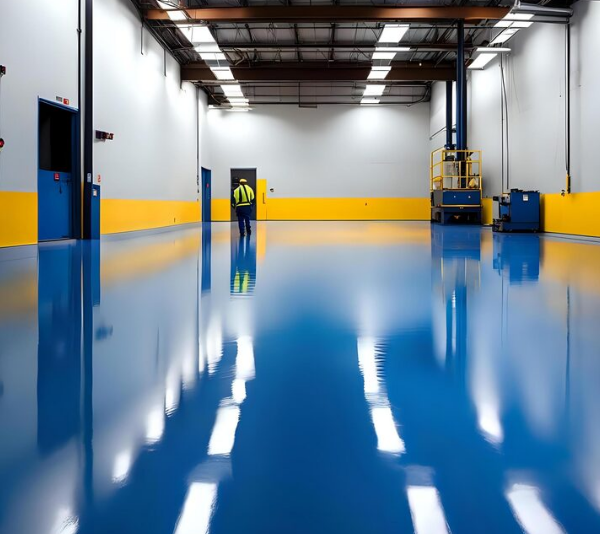
non slip epoxy floor systems provide a fundamentally different solution. Understanding the mechanism explains why they perform better in demanding conditions — and why they produce a different visual outcome.
An epoxy floor system starts with substrate preparation: mechanical grinding or shot blasting to create a profile the epoxy can mechanically bond to. This step determines whether the coating performs over time. Without adequate surface profile, the epoxy bonds to the surface layer and eventually delaminates.
The epoxy base coat is applied and, while still wet, aggregate is broadcast across the surface. For a non slip epoxy floor specification, the aggregate is typically aluminium oxide, silicon carbide, or a combination. These materials are harder than the epoxy matrix, so the aggregate peaks that protrude above the cured surface are the most abrasion-resistant points of the floor. As the coating cures, the aggregate becomes permanently embedded — bonded into the epoxy matrix, not glued on top.
A seal coat applied over the aggregate locks the particles in place and provides the chemical resistance properties of the epoxy system. The finished floor has a measurable, visible, tactile textured profile verifiable against a friction standard.
The friction mechanism in an aggregate system differs from in-surface treatment. Rather than micro-channels preventing hydroplaning, the aggregate creates macro-asperities that protrude through any fluid film. Even substantial water or oil cannot fully submerge the aggregate peaks — the foot contacts the aggregate directly.
What DCOF Means and Why It Is the Number That Actually Matters
Both in-surface treatments and anti slip coatings are evaluated using the same measurement: Dynamic Coefficient of Friction (DCOF). Understanding what this number represents — and what it does not — is essential for evaluating any slip resistance claim.
DCOF measures the ratio of friction force to normal force during motion — how much resistance a foot moving across a wet floor encounters per unit of downward force. A higher DCOF means more resistance. More resistance means less likelihood of the foot sliding.
The measurement is made with a calibrated tribometer dragging a standardised test pad across the surface under wet conditions. For most pedestrian floor surfaces, a wet DCOF of 0.42 or above is considered the minimum safe threshold. Ramps, areas with oil or grease contamination, and environments used by elderly or mobility-impaired individuals require higher values.
What DCOF does not capture: the effect of contaminants other than water. A floor achieving 0.55 DCOF with water may perform significantly differently with soap film or cooking oil. For environments with specific contamination profiles, the friction standard should reflect the actual contaminant — which is why a pool surround, a commercial kitchen, and a hotel lobby all require different treatment specifications.
A professional provider of anti slip coatings should be able to state the expected DCOF of the treated surface under the specific conditions of the installation, test the result after application, and provide a certificate that records the measured value. A provider who quotes a DCOF range without measuring the specific surface, or who cannot test and certify the result, is not providing a professional service.
Why Some Treatments Fail Early — And What That Tells You About What to Look For
The failure modes of anti slip coatings are instructive. Most premature failures trace back to one of three causes, and understanding them tells you what to ask before any treatment is applied.
Inadequate surface preparation is the most common cause. For in-surface treatments, it means the tile was contaminated when the treatment was applied — the chemistry reacted with the contamination rather than the tile. For epoxy systems, it means insufficient surface profile and eventual delamination.
Wrong chemistry for the substrate is the second cause. Different tile and stone types require different treatment formulations. A treatment calibrated for glazed ceramic applied to natural marble can produce insufficient reaction depth or visible etching. The chemistry must be matched to the specific substrate.
Non slip floor covering treatments and in-surface modifications are both vulnerable to specific cleaning chemistries. High-alkalinity cleaners and strong acid descalers, applied repeatedly over months, can degrade both the micro-channels created by in-surface treatment and the adhesion of epoxy coating systems. The treatment that was applied correctly will eventually fail if the maintenance protocol uses incompatible products.
This is why Non Slip Concrete And Floor Coating Services in Dubai providers and Anti Slip floor Solution and Flooring experts in Dubai who understand the full picture will always specify compatible cleaning products as part of the job scope — not as an afterthought, but as an integral part of ensuring the treatment performs for its intended lifespan.
What This Means When You Are Choosing a Treatment Provider
The science of anti slip coatings translates directly into practical questions you should ask before commissioning any treatment. These are the questions that distinguish a technically competent provider from one who is applying a product without a full understanding of what it needs to achieve.
What is the chemical mechanism of this treatment on this specific tile? The answer should be specific: acid-based etching, enzymatic modification, or a named formulation with a product data sheet. “It creates grip” is not an answer. The mechanism tells you whether the treatment is appropriate for the substrate and what to expect in terms of longevity.
What surface preparation is being done, and why? For in-surface treatments, the answer should include cleaning method and contaminant removal protocol. For epoxy systems, it should include surface profile measurement and moisture testing. A provider who does not describe preparation in detail is likely skipping it.
What DCOF will the treated surface achieve, and how will it be tested? A specific number, a specific test method, and a commitment to verify the result after application. The certificate that follows is the evidence that the treatment achieved what it was specified to achieve.
What cleaning products are compatible with the treatment? The answer should be specific enough to inform the maintenance team. A generic “avoid harsh chemicals” is not sufficient.
The floor science is established. What varies is the competence of the people applying it. Asking the right questions before the job starts is the most reliable way to ensure the result is what was promised.
The Questions Underneath the Questions
What people genuinely want to understand when they ask about anti slip treatments — and what usually goes unspoken.
If the treatment is invisible, how do I know it actually worked?
You test it. Grip is a number, not a feeling. A professional treatment should be followed by a tribometer test recording wet friction coefficient before and after. Before: typically 0.25–0.35 for a polished tile. After: 0.50–0.70. The number is the evidence. Asking for the test result is the normal standard of a professional job.
Why does one provider’s treatment cost significantly more than another’s for the same area?
The cost difference comes back to preparation, chemistry, and documentation. A higher-cost provider uses chemistry matched to the specific substrate, prepares the surface properly, and provides a post-treatment friction certificate. A lower-cost provider typically uses a generic product with minimal preparation and no verification. The treatment may look similar on day one. At twelve months, the performance difference is usually clear.
Can the treatment be applied to old tiles that have been cleaned for years with strong cleaning products?
Yes, but preparation is more demanding. Years of descaling and oil-stripping products leave a complex residue. The treatment chemistry needs to reach the tile glaze, not the contamination layer. This requires a stripping process first. A provider who does not ask about cleaning history and does not include a preparation step is likely to produce a partial and short-lived result.
How does the treatment perform on textured tiles that already have some grip?
Textured tiles already have surface asperity, so they start from a better position than polished tiles. However, shallow texture can still be flooded by soap film, oil, or mineral deposits. In-surface treatment enhances the existing texture rather than creating it. Whether treatment is necessary depends on the current DCOF under the specific conditions of use — a test, not a visual assessment.
Does the treatment affect grout lines differently from the tile surface?
Yes. Grout lines are a cement-based compound with a naturally porous, textured surface — different from the tile glaze. Most professional treatments are formulated for the tile surface and neutralised before they have significant effect on grout. This is generally not a problem because grout lines typically already have adequate grip — the friction deficit is in the tile surface between them.
I’ve seen anti-slip sprays and liquids sold online. Are these the same thing as professional treatment?
Consumer anti-slip products typically deposit a thin friction-enhancing layer that wears or washes off within weeks to months, or contain a diluted acid producing a mild surface reaction. Both effects are temporary. Neither achieves the micro-channel depth of a professional treatment. For any surface where safety is the primary concern, professional treatment with a verified DCOF result is the correct specification.
Is there any tile surface that cannot be treated for slip resistance?
Very few — but chemistry varies significantly by substrate. Porous natural stone requires different chemistry from dense polished marble, which differs from glazed ceramic and vitrified porcelain. Surfaces with penetrating sealer need removal first. Some decorative finishes require enzymatic rather than acid-based formulations. The correct approach is determined by assessment, not assumption.